

Star Wars – China harbors military ambitions in space
Hong Kong, August 12 (ANI): Space is a critical domain for China's military war machine, the People's Liberation Army (PLA). Indeed, China is Asia's undisputed space champion, and it is increasingly alarming the USA with its rapidly expanding capabilities.
Indeed, the US intelligence community's Annual Threat Assessment issued a few months ago specifically stated: "China has eclipsed Russia as the key US competitor in space. Beijing's rapid deployment of space capabilities positions it to use space to advance its foreign policy goals, challenge US military and technological superiority in space, and project power on a global scale."
That statement illustrates just how far China has come. Its space capabilities now surpass those of Russia, the first country in the world to launch a satellite. In 2025, China conducted 92 orbital liftoffs, remembering that China's whole space program - whether labeled civilian or military - is handled by the PLA. This compares to the USA, which clearly separates civilian and military space efforts through NASA and the Pentagon respectively.
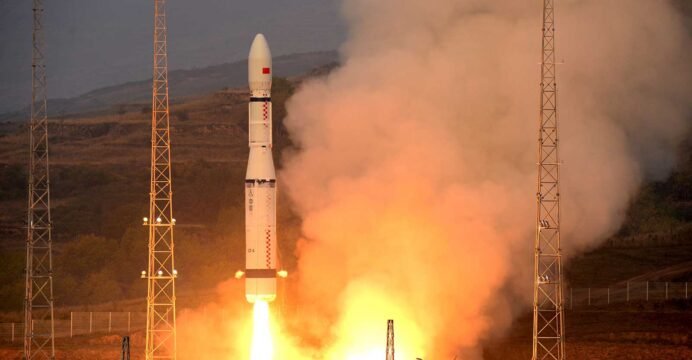
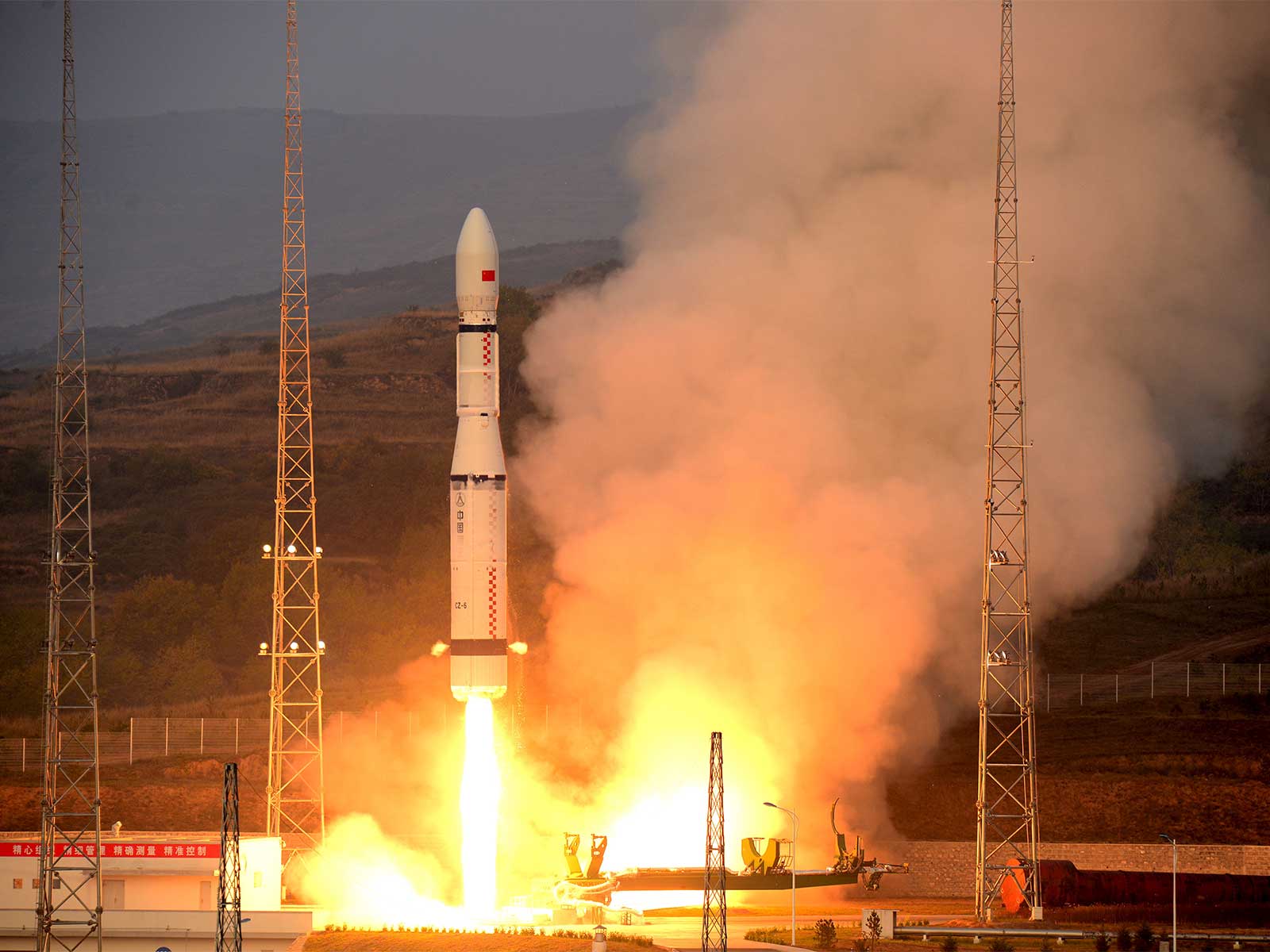
Under paranoid levels of secrecy, Chinese satellite activities are far more expansive than those of the USA. Nor is Beijing merely seeking parity with American space capabilities, for it wants dominance in this space race. In fact, the PLA possesses six China-based spaceports that can launch into orbit new-generation heavy-lift rockets bearing entire satellite constellations. China will also attempt to perform a manned Moon landing by 2030.
Chinese official documents have referred to space as the "commanding heights" housing "indispensable strategic supports for winning informationized wars". They also describe space as a "critical domain in international strategic competition". The PLA's important 2020 document Science of Military Strategy argued, "In the context of the new military revolution, space has already become a new domain of military conflict, not only changing the traditional form of warfare of mankind, but also expanding the struggle for national strategic interests."
This is true, for the USA's aforementioned Annual Threat Assessment warned: "Disruptive attacks against space services have become more common and probably will be normalized during crises or periods of strained relations between nations. Adversaries are using jammers against US satellites, and the risks stemming from cyberattacks against satellite communications (SATCOM) are also growing as global reliance on digital systems expands the number of exploitable cyber vulnerabilities associated with space services."
Key amongst what the USA calls "adversaries" is China. In fact, there is growing evidence that Beijing is rehearsing how to use space-based assets to perform offensive and counter- space operations. It has already been observed conducted "dogfights" in space. In March 2025, for instance, the US Space Force (USSF) observed "five different objects in space maneuvering in and out and around each other in synchronicity and in control," according to General Michael A. Guetlein, Vice Chief of Space Operations. Guetlein elaborated, "That's what we call 'dogfighting in space'.
They are practicing tactics, techniques and procedures to do on-orbit space operations from one satellite to another". As an example from 2022, the American patrol satellite 'USA 270' reportedly had a pair of recently launched Chinese satellites in its sights dead ahead whilst they were transiting "one of the most sensitive neighborhoods in space". However, one of the Chinese satellites then slowed down and maneuvered in behind 'USA 270' as it flew past, 22,000 miles above Earth.
While nobody was shot down - as occurs in real jet fighter combat - this encounter left American controllers wondering how to pilot their satellite's next move. It also raised questions about Chinese intentions, as the latter refines its ability to affect rapid aspect changes in its satellites. Half the problem is that China refuses to divulge its true space ambitions, despite claiming only peaceful and benign intentions. For example, Liu Pengyu, the Chinese Embassy spokesman in Washington DC, said in December 2025: "China is committed to the peaceful use of outer space, and opposes any arms race in outer space or weaponizing it.
China has no intention to engage in a space race with any country, nor do we seek so-called advantage in outer space." However, China's actions speak otherwise. It is the same on Earth in places like the South China Sea. Beijing cloaks its plans and actions in reassuring phrases, but it is busily stoking tensions by throwing its weight around. China has hastened development of satellite mega-constellations to provide SATCOM resilience, plus the country's thriving commercial space sector is driving innovation that benefits the PLA. It is also developing reusable rockets.
The Pentagon's 2025 report on China's military noted, "Many of China's commercial companies are part of its military-civil fusion strategy to develop dual-use technologies in the commercial sector for eventual integration into the military. In 2024, commercial space development was written into the Chinese Communist Party's (CCP) government work report for the first time, demonstrating its increased importance."
Are some of China's satellites designed to wage war against the space-based assets of other nations in orbital skirmishes? Does China intend to blind an adversary's sensing capabilities and shut down vital communications in a war or at some other critical juncture? Yes, both situations are extremely likely.
The Chinese TJS-3 satellite, for example, has approached other countries' satellites in geostationary Earth orbit multiple times. Yet China says it is just a communications technology test satellite. Beijing has also conducted close approach and rendezvous operations between different sets of satellites. Some, like Shijian-21, have robotic arms that can manipulate and reorient other satellites. As another example, throughout 2024 the Shiyan-24C satellite trio demonstrated its ability to conduct complex rendezvous and proximity operations, sometimes approaching within 1km of each other. The fact is that these kinds of dogfights have become common in space. It is now an everyday activity for one nation to spy on the satellite of a competitor. This could involve photographing the satellite and analyzing what is externally visible. In other cases, it entails monitoring the data transmissions that a satellite emits and receives.
China currently has more than 970 surveillance satellites in orbit. These can spot and track targets such as military bases, expeditionary forces and aircraft carriers. The USSF reported that from March-June 2024 alone, the PLA launched 20 satellites designed to facilitate "long- range precision strikes against US and allied forces." Such information is vital in the Indo-Pacific region, a vast maritime area where satellite sensors can monitor military assets and units.
As Reuben F. Johnson wrote in an article for the Asian Military Review journal, "The point is just how critical the use of satellites will be during any conflict in the Asia-Pacific theater, compared to other parts of the world. Space has now become a new battleground in Asia, one in which up-to-date information on the location and disposition of an adversary's forces is far more critical than in the European region of operations."
Last year the US Army's Training and Doctrine Command issued a report called How China Fights in Large-Scale Combat Operations. It stated: "To achieve information dominance, China's aerospace forces will launch cyber, kinetic and directed-energy counter-space operations against the enemy's communications; positioning, navigation and timing; and intelligence, surveillance and reconnaissance assets to deny the enemy the ability to communicate, navigate and understand enemy intentions." Such official statements emphasize the importance of China's counter-space capabilities.
The Pentagon also noted, "China perceives that the US military heavily relies on space for intelligence collection and communications, and China is developing counter-space capabilities designed to restrict US use of space and space-enabling technologies in a conflict. The PLA almost certainly plans to conduct terrestrial and space-based kinetic and non-kinetic anti-satellite (ASAT) operations during a conflict with the United States, and will adapt employment strategies as new capabilities are fielded." Its varied array of ASAT methods includes cyberattacks on ground and control systems, global navigation satellite system "spoofers", lasers, jammers and anti-satellite missiles. China can execute such methods with little warning.
In 2007, China demonstrated its ASAT ability by destroying an orbiting, defunct satellite with a ground-launched missile. The Pentagon stated, "Interfering with synthetic aperture radar satellites very likely protects terrestrial assets by denying imagery and targeting in any potential conflict involving the United States or its allies. China is also probably developing jammers to target SATCOM over a range of frequency bands, including extremely high-frequency communications used by the US military." By jamming signals between Earth and space, as well as jamming actual satellites, China could prevent early warning of a missile launch on Earth, conceal something on the ground from a sensor, or interfere with communications between a commander and their troops.
The researchers Howard Wang, Gregory Graff and Alexis Dale-Huang authored a RAND Corporation report called China's Growing Risk Tolerance in Space. They concluded that the PLA views the USA with "a profound sense of threat" and "deep suspicions". Elsewhere, PLA analysts have characterized Trump's 2020 Defense Space Strategy as blatantly securing and extending US "space hegemony". The RAND researchers thus remarked, "As a result, Chinese leaders have inflated threat perceptions of the United States and are unlikely to cooperate with US officials to arrest unintended crisis escalation. Instead, CCP leaders are more likely to direct the PLA to compete rather than cooperate with the United States and USSF."
In 2023, the director of China's Ministry of State Security-affiliated China Institutes of Contemporary International Relations Arms Control Research Center argued that the USA's "bravado" in space has increased the risk of space war, and as a result of US policies, "the current risk of a space war has far surpassed that of the Cold War." The RAND report added, "To prosecute competitive strategies against the United States, the PLA is likely to adopt aggressive deterrence operations in the space domain, up to and including the use of lethal force."
They also warned that the PLA's greater appetite for risk "likely makes space a riskier operating environment for all countries operating in this domain. In conjunction with the CCP's enduring suspicion of US intentions, this policy of risk-accepting behavior and reluctance to cooperate on US initiatives might result in unintended escalation with the United States." This will be exacerbated by the fact that, in the event of a crisis in space, there is very unlikely to be sustained communication channels with China. They assessed that China's leadership has "pushed the PLA toward a more proactive and risk-accepting posture, likely composing a new normal of heightened friction in day-to-day space operations."
As Johnson noted in his Asian Military Review article, "The militarization of space, with the PLA in the lead, is no longer a theoretical construct. It is happening today." The RAND writers remarked, "The PLA's push to proactively shape its strategic environment indicates that USSF will face a bellicose PLA eager to assert itself in space during peacetime, though the PLA remains unlikely to escalate in a way that risks its political imperatives. Particularly because PLA leaders appear to anticipate low costs for escalating in space, USSF should anticipate that PLA provocations in peacetime likely comprise a new normal in day-to-day space operations that involve China." The space race is alive and well.
General Stephen Whiting, Commander of the US Space Command, warned that China and others are maneuvering their spacecraft in ways "that may enable them in a conflict to try to derive a position of advantage relative to the United States. So we want to make sure that we stay ahead as the world's leading space power, and that we develop our own maneuver capabilities to remain in a position of advantage and to defend ourselves." (ANI)
