

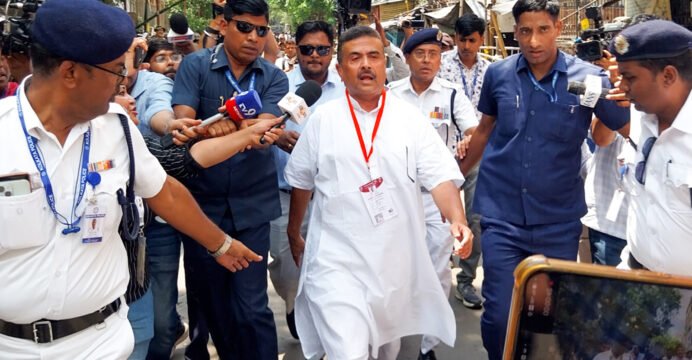
Saffron sunrise: Suvendu Adhikari hails a “new dawn” for West Bengal

Kolkata (West Bengal) [India], May 4 (ANI): In a post vibrating with political triumph and emotional gravity, Leader of Opposition Suvendu Adhikari declared a "New Dawn for Sonar Bangla" following a historic electoral mandate.
In a post on X, Adhikari framed the BJP's performance as a definitive rejection of the status quo and a full-throated embrace of Prime Minister Narendra Modi's vision for the East.
Adhikari characterised the election results as a "testament to the unwavering faith" the people of West Bengal have in the Prime Minister. By linking the state's future to the national goal of Viksit Bharat (Developed India), he signalled a shift toward integrated regional growth.
"The dream of a Viksit Bharat will now be realised through a decisive mandate for Nationalist BJP Governments across the Anga-Kalinga-Banga region. Our @BJP4Bengal Karyakartas have watered this Victory with their blood and sweat. It is the Hon'ble PM's unwavering commitment to development and the People's desire for change that have made this possible. I bow to the People of West Bengal for choosing progress over fear. Together, we shall rebuild West Bengal. Jai Maa Kaali Jai Shree Ram," the post added.
His reaction came after Prime Minister Narendra Modi posted on X over the saffron surge in West Bengal, ending Mamata Banerjee's 15-year TMC rule.
"BJP's record win in West Bengal would not be possible without the efforts and struggles of countless Karyakartas over generations. I salute them all. For years, they have worked hard on the ground, overcome all sorts of adversities and spoken about our development agenda. They are the strength of our Party," PM Modi posted.
What was once considered an impregnable stronghold of the All India Trinamool Congress (TMC) has now turned into the BJP's biggest eastern triumph, reshaping the political map of the state in a way few had anticipated.
As counting progressed across the state's 293 constituencies, the BJP surged far beyond the majority mark of 147 seats, ultimately establishing an overwhelming lead with 207 seats (including wins and leads). In stark contrast, the TMC lagged at just 80 seats, a massive decline from its previously dominant position.
Smaller parties remained largely peripheral in the final tally, with the Congress and Aam Janata Unnayan Party picking up two seats each, while the Communist Party of India (Marxist) and the All India Secular Front managed just one seat apiece.
Out of all constituencies, results for 254 seats were declared, with 39 still reflecting leads at the time--yet the broader picture was unmistakable: Bengal had chosen a new political direction.
Despite the BJP's sweeping seat victory, the vote share revealed a more competitive undercurrent. The party secured 45.84% of the vote, while the TMC followed closely with 40.80%, highlighting that the electoral battle remained fiercely contested at the grassroots level.
The CPI(M) garnered 4.45%, and Congress secured 2.97%, while other smaller parties and independents collectively contributed around 4.28%. The numbers suggest that while the BJP translated its vote share into a decisive seat advantage, the Opposition retained a substantial voter base--pointing to a divided yet shifting electorate.
Perhaps the most symbolic and politically consequential moment of the election came from the Bhabanipur constituency, long considered a bastion of Mamata Banerjee herself. In a stunning upset, Suvendu Adhikari of the BJP defeated Banerjee by a margin of 15,105 votes. Adhikari secured 73,917 votes against Banerjee's 58,812, while CPI(M)'s Shrijeev Biswas trailed far behind.
The loss not only marked a personal setback for Banerjee but also underscored the scale of the political shift underway in West Bengal.
Prime Minister Narendra Modi hailed the BJP's sweeping victory in West Bengal as a "historic fulfillment" of the dream of Dr. Syama Prasad Mookerjee. For the BJP, this win transcends politics; it is the ultimate validation of their founder's mission to secure and prosper the state.
In 1947, Mookerjee was the decisive voice against the "United Bengal" plan. He successfully argued that if India was partitioned, the Hindu-majority regions of Bengal must remain part of the Indian Union. After resigning from Nehru's cabinet in 1950, Mookerjee collaborated with MS Golwalkar (RSS) to create a political alternative. In 1951, he founded the Bharatiya Jana Sangh, the direct organisational ancestor of the modern-day BJP.
Reacting to the results, Prime Minister Narendra Modi hailed the outcome as a historic mandate for development and governance. Calling it a triumph of "people's power," PM Modi emphasised that the BJP's victory was the result of years of dedication by party workers.
Addressing jubilant supporters, he framed the moment as one of national significance, stating that the results reflected trust in democracy and the "politics of performance." He also urged party workers to focus on change rather than revenge, appealing for an end to political violence that has often marred elections in the state. (ANI)
