


India AI Impact Summit 2026 Convenes Global Leaders on Open Data Regulation; Panel Calls for “Structured Openness”
VMPL
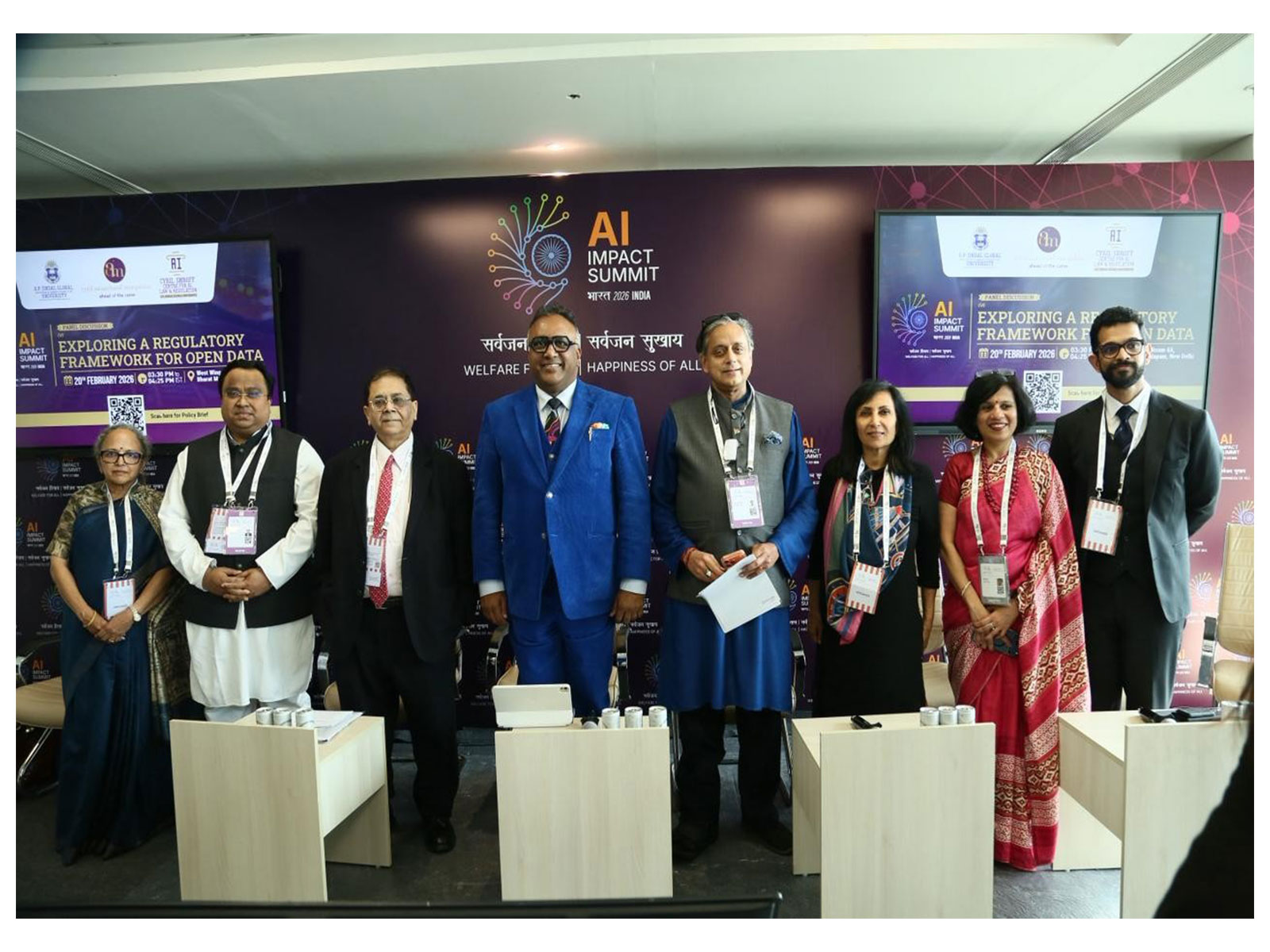
New Delhi [India], February 23: The Cyril Shroff Centre for AI, Law and Regulation at Jindal Global Law School, O.P. Jindal Global University, in partnership with Cyril Amarchand Mangaldas, convened a high-profile panel titled "Exploring a Regulatory Framework for Open Data" at Bharat Mandapam as part of the India AI Impact Summit 2026.
Dr. Shashi Tharoor, Member of Parliament (Lok Sabha) for Thiruvananthapuram, delivered the keynote address, framing data governance as a question of power, sovereignty and value extraction and advocated for "structured openness", an approach that prioritises open data infrastructure while deliberately building guardrails and domestic capacity to prevent inequalities and external dependency.
The session was moderated by Professor (Dr.) C. Raj Kumar, Founding Vice-Chancellor and Dean, Jindal Global Law School, O.P. Jindal Global University, who guided the discussion on whether data sharing should move from a voluntary practice to an institutional duty backed by statute.
Mr. Cyril Shroff, Managing Partner, Cyril Amarchand Mangaldas, argued for a statutory and regulatory open-data framework to overcome government data siloing and provide the legal certainty that fosters investor confidence, responsible innovation and market-led growth.
Mr. Arun S. Prabhu, Partner & Co-Head (Digital | TMT Practice), Cyril Amarchand Mangaldas, emphasised that effective open-data governance requires the law to systematically address operational issues - anonymisation, standardisation, purpose-limitation, while clearly defining the objectives for data sharing.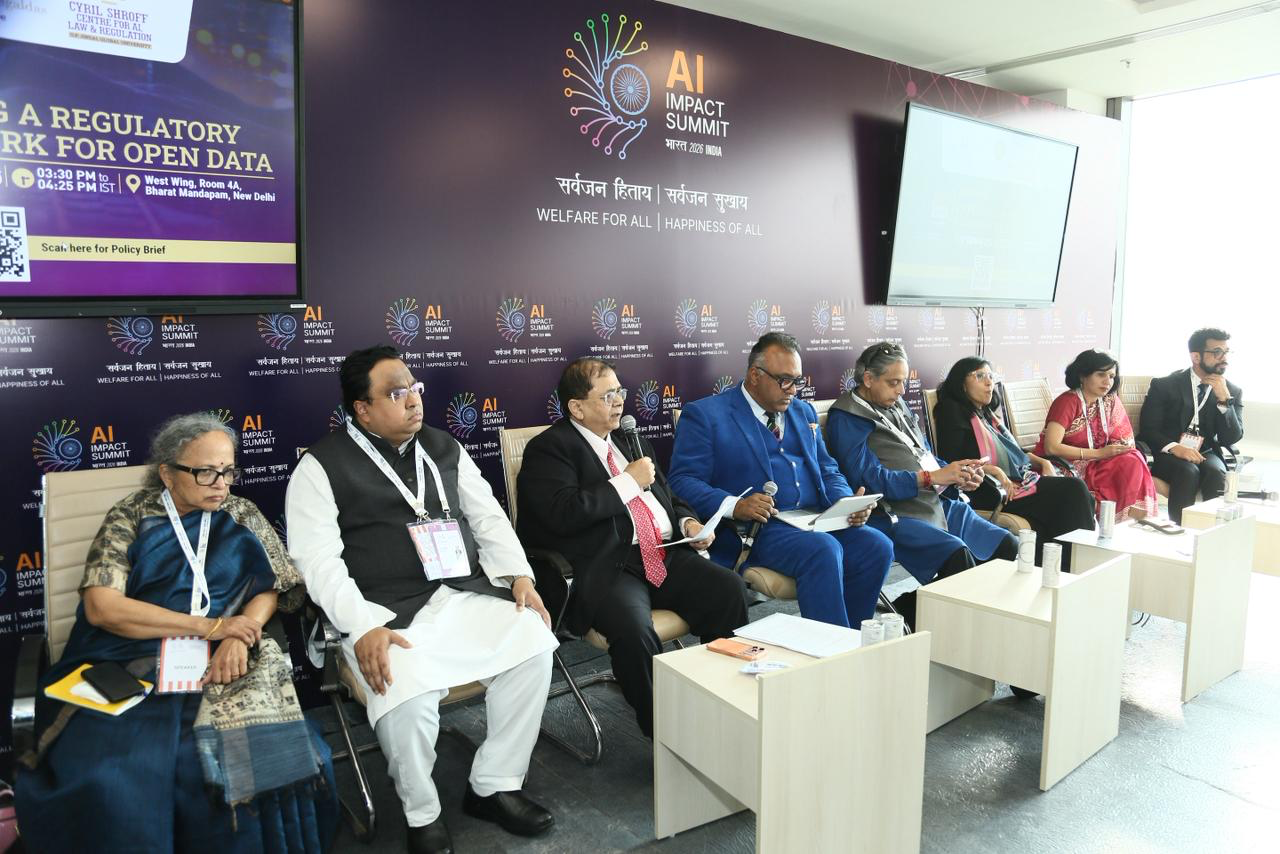
Ms. Rama Vedashree, former Chief Executive Officer, Data Security Council of India (DSCI), highlighted that India's open-data ecosystem often lacks machine-readability, rich metadata and interoperability, and that "open" must increasingly mean usable for AI and other advanced applications.
From the private sector, Ms. Irina Ghose, Managing Director, Anthropic (India), underlined the need for a trust continuum from data origin to end-use and proposed concepts such as a "model context protocol" to enable contextual, local-language and domain-specific data to be usable at scale for AI applications.
Dr. Sasmit Patra, Member of Parliament (Rajya Sabha), noted how a trusted, reliable data infrastructure is essential for evidence-based policymaking and cited AI-driven crop-loss prediction as a high-impact public-interest use case.
Ms. Asha Jadeja Motwani, Founder, Motwani Jadeja Foundation, synthesised the discussion and called for enforceable open-data laws, recognition of public data as core digital infrastructure, and stronger international alignment to advance shared global AI governance aims.
Speakers emphasised that open data must increasingly mean usable, and that datasets should be machine-readable, richly annotated, and provided through AI-ready public data infrastructure (APIs, interoperability standards, and reliable, scalable access) so they can safely power public-interest AI applications. The session concluded that a combination of enforceable law, technical standards and international cooperation will be central to a workable open-data regime suitable for the AI age.
The India AI Impact Summit 2026 brought together global leaders from government, industry, and civil society at Bharat Mandapam, New Delhi, to deliberate on collective principles and actionable roadmaps for AI governance and ecosystem development.
(ADVERTORIAL DISCLAIMER: The above press release has been provided by VMPL. ANI will not be responsible in any way for the content of the same.)
