

How AI Is Reshaping India’s IT Jobs: 30% Less Hirings, Vanishing Mid-level Roles
HT Syndication
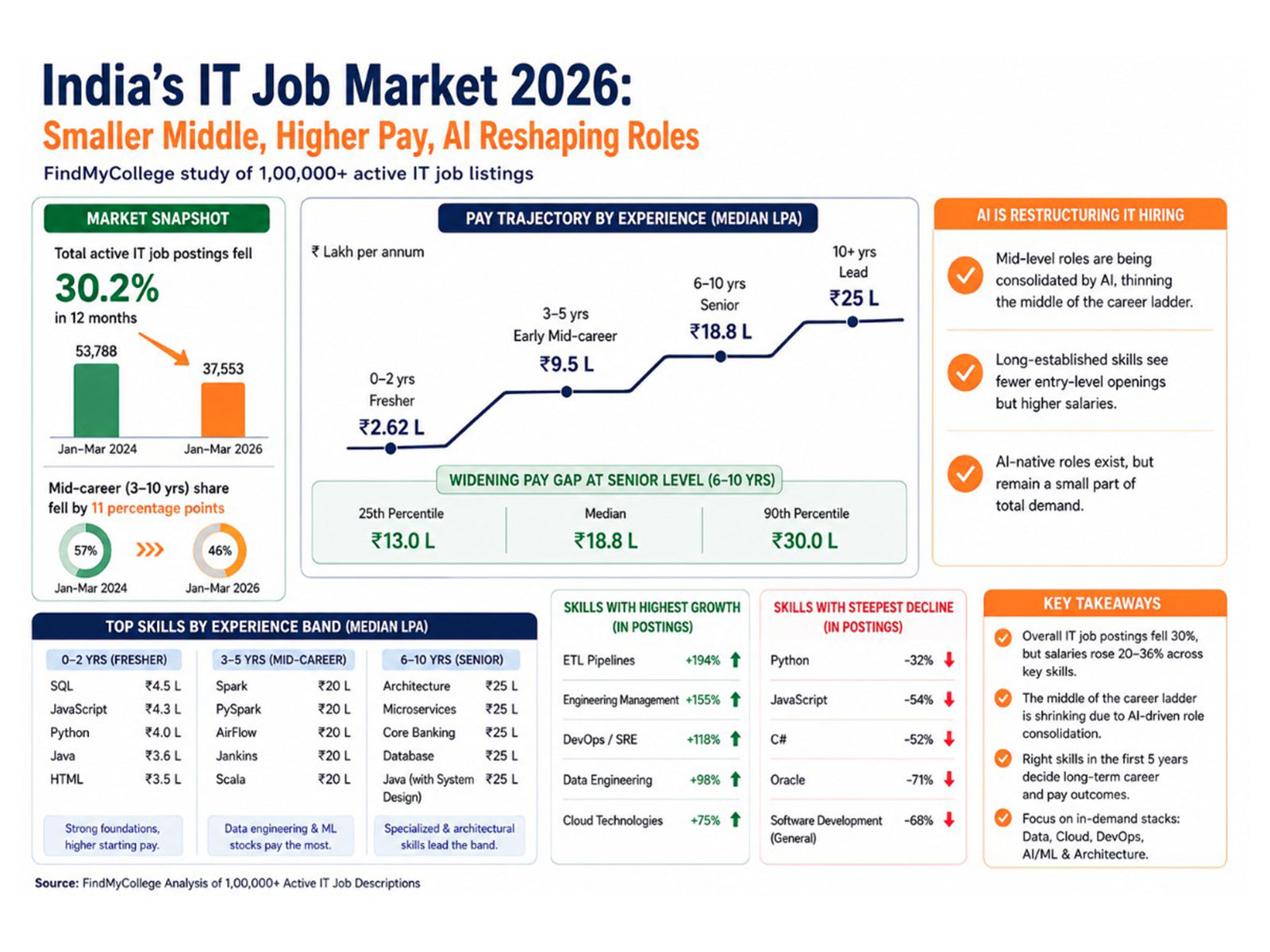
New Delhi [India], June 15: A study conducted by FindMyCollege, covering more than 1 lakh active IT jobs in the current market, finds the pay ladder starting at a median of ₹2.6 LPA (lakhs per annum), rising to ₹25 LPA for experienced roles. However, a new mid-career band gap has emerged. This segment has also been historically the largest in the Indian IT sector, making up nearly 57% of the IT hirings in the market. But, currently, its getting strangled due to artificial intelligence consolidating many roles. The mid-level SDE segment has witnessed a dip of 11 per cent in hirings in just 12 months.
For an Indian IT graduate stepping into the job market, it starts with ₹2.62 LPA on average. Cling on to it for a couple of years, basically three to five years, and the salary figure inflates to ₹9.5 LPA. Moreover, a decade into the IT sector, the salary explodes to more than double again to ₹25 LPA. However, this job trajectory demands constant upskilling along the way, steering you into more demanding IT roles.
Another surprising fact is that most Indian IT graduates won't make it even to the upper half of any of these bands. Where an IT graduate will project surprisingly, a small skill set to make the job market actually pay them, and also the market decides this early. The gap between a BTech graduate getting a head start and the one stalling behind usually becomes pretty evident between year one and year five.
However, this set of rewarded skills has shifted drastically in the past twelve months. FindMyCollege has analysed 37,553 active IT job descriptions and compared these with 53,788 listings from the past year. The picture that emerged isn't the one to make headlines. But still, the IT career path isn't collapsing just yet. And also, it hasn't exploded with AI jobs; it's getting quietly restructured.
But one thing is pretty clear: the middle of the ladder is thinning out. Skills like Python and JavaScript now pay more, even in the entry-level roles that demanded them dry up. Meanwhile, a new category is emerging, i.e., AI-native roles. And it's for real, however, currently minuscule for everything that contraction has taken away.
Pay trajectory by experience.
The salary progression is pretty straightforward; on average, ₹2.62 LPA becomes ₹25 LPA in a decade's time. The doubling between intermediate years of 1-2 and 3-5 is the steepest in the salary ladder. And this steep climb is directly linked with the skills an IT professional builds during the first two years of their career. Within every band, the gap between the 25th and 75th percentile is wide, and this gap explodes exponentially at the senior levels. A median 6-10 year IT professional earns 18.8 lakhs, the 75th percentile earns ₹23.75 LPA, and the 90th percentile earns ₹30 LPA. The width of the band, not the median, is where careers get transitioned to.
The full interactive report is at: https://findmycollege.com/research-it-career-skill-map-india-2026 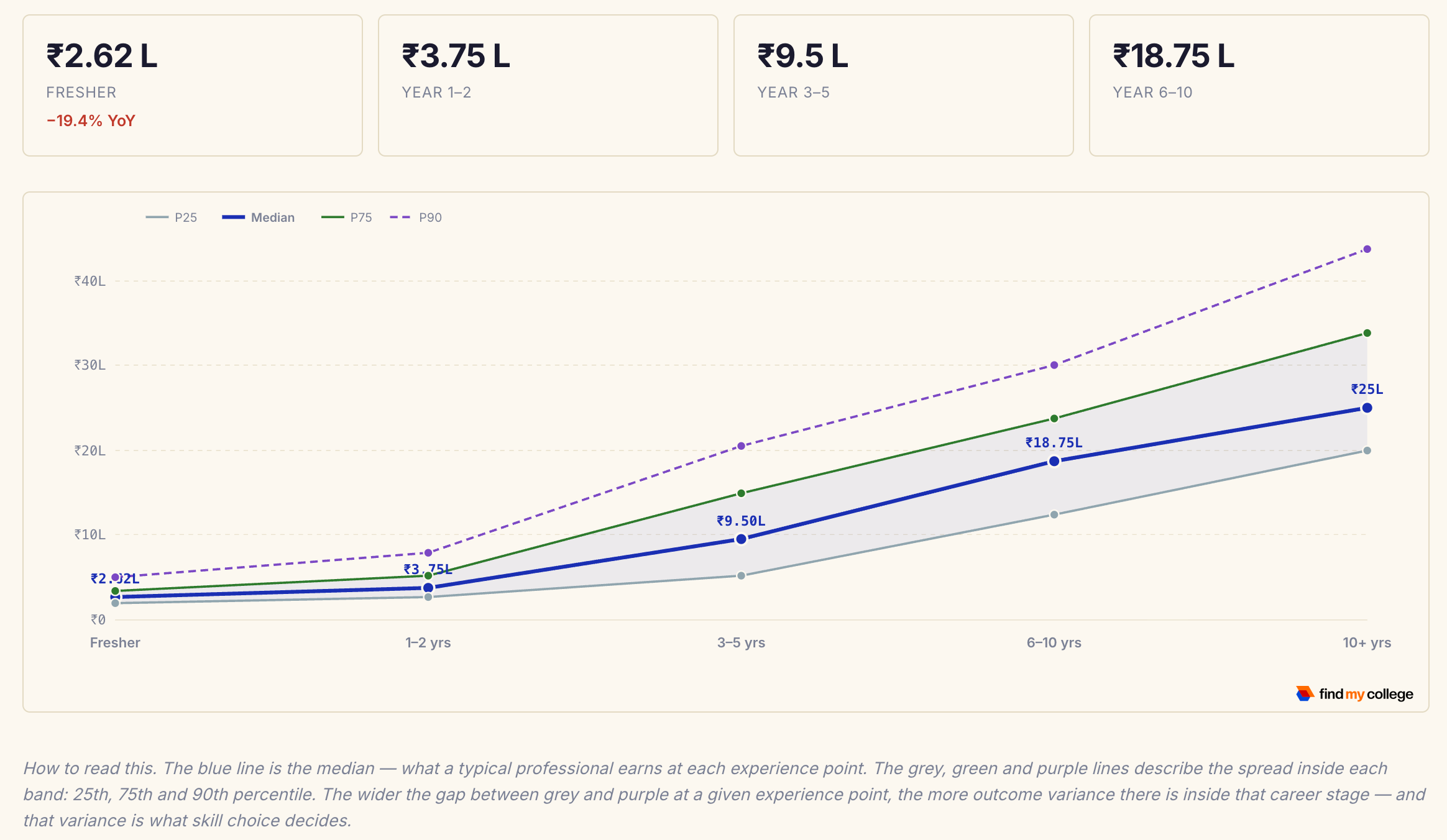
Skills that decide pay at each band
The skill set that moves a fresher above the 2.62 LPA average isn't something celestial. They are built on foundational knowledge of SQL, JavaScript, Python, Java, and HTML. Each of the postings whose median pay lies in the range of ₹3.5 to ₹4.5 lakhs, roughly a lakh above the baseline. The list will look very familiar to the one who has skimmed through the engineering syllabus. What separates the BTech graduates who clear this bar from those who do not is rarely what they have studied; it's what they have built outside their course curriculum.
The next band is where the ladder bifurcates. Years three to five are the only experience step in the entire career where average pay doubles up and not for every BTech graduate. Spark, PySpark, Airflow, Jenkins and Scala all pay medians of ₹20 lakh in this band. Machine learning, Python and Django pay ₹15-16 lakh. Generic enterprise development sits below this. The pattern is hard to miss: data engineering and machine-learning stacks reward this band the most. However, classical web development pays meaningfully less. The company chosen for the stipend, reasons in a year less than the project, which lets a graduate touch one of the stacks by year three.
At the senior level, the skills that matter shift the salary gear shifts again. Architecture and microservices command medians of ₹25 lakhs. Other segments, like core banking and database management roles, sit at the same level. Java, a mid-career staple in the previous decade, now appears at the senior level, paying ₹25 lakh. However, this happens only in hiring that involves system design responsibilities additionally. By this point, the skill stack becomes layered and not flat. IT graduates who choose generalist roles in years 3 to 5 often find it very difficult to reach this level.
Findings from FindMyCollege: FindMyCollege.com is India's college search and discovery platform. It serves over five million student searches a year across thousands of institutions. The platform provides college information, cutoff data, and student-verified reviews.
What has changed in 12 months
The picture in the IT sector has totally changed. The skills the IT market rewarded twelve months ago were very different from what it rewards today. The active inventory has contracted across domains; total IT hirings fell from 53,788 in January-March 2024 to 37,553 in January-March 2026. This is a straight drop of 30.2%. However, this contaction hasn't been uniform.
A small number of specific skills have visibly come into play from the employer's side. ETL pipelines, engineering-management responsibilities and certain development-methodology tags are among the demanded skills. However, the signal is narrower than headlines about AI's gigantic rise might suggest. Still, overtly AI-native skill tags remain a small share of IT postings. The real growth has been seen in
cloud and data orchestration, not yet in LLMs (Large Language Models).
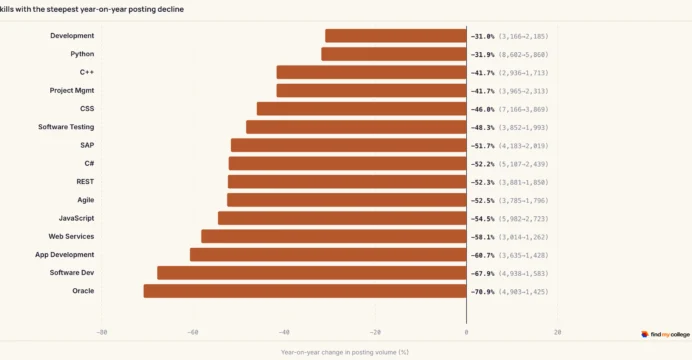
The decline in certain IT domains is daunting. Python-based hirings fell by 32%. Also, JavaScript hirings fell by 54%, and C# fell by 52%. Oracle, the database that powered an entire generation of Indian IT, fell 71%. Adding to this, generic "software development" tags fell 68%. Reading these numbers alone, the traditional IT industry seems to be on its deathbed. Well, it's not. Pay attached to each of these skills rose by 20 to 35% across the same period. What has disappeared is the easy and basic entry-level IT roles. The role consolidations have happened for sure, but not for the skill itself. However, this consolidation is the clearest evidence of the data of AI quietly rewriting the IT job market.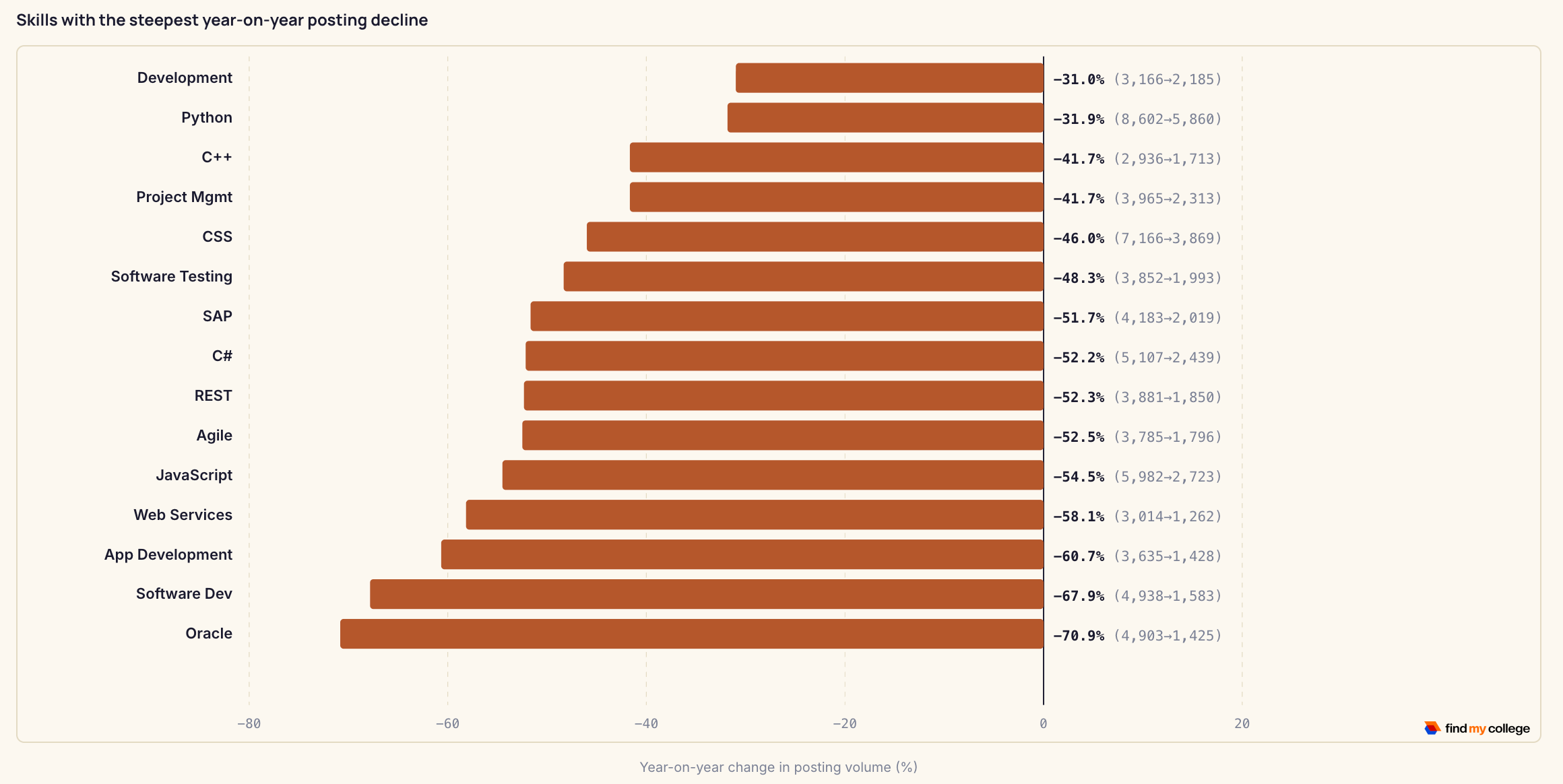
For any queries contact FindMyCollege Research Team: support@findmycollege.com
How AI is reshaping IT hiring
Ideally, the headline of AI's effect on the Indian IT sector shouldn't be vast AI native job roles, but rather it should be a niche segment of fast-growing, consolidating roles. The much larger story sits in what AI is doing to the other 93% of the IT roles. The decline-with-rising-pay pattern in classical skills is one signature of that change. Three more findings sit in the data.
3 Major Job Hiring Signatures
The first is the simple fact of the overall contraction in the IT job market. India's economy didn't shrink between January-March 2024 and January-March 2026. However, this can't be said for the Indian IT sector, as IT-specific demands dipped nearly one-third. This gap reflects productivity gains being absorbed by employers as fewer net hires per unit of output.
The second, which is the most underdiscussed, is the coverage of AI's effect on jobs and the one with the sharpest implications is for college students. Fresher IT postings actually grew 25% YOY basis from 1334 to 1665. But the median fresher's salary fell 19% from 3.25 lakhs to 2.62 lakhs. At the same time, the share of IT postings with 10+ years of experience grew from 6.2% to 10.3%, a one-third increase. The 3 to 5 year job band, historically the largest in the IT sector, witnessed the sharpest fall. This band fell from 56.5% to 45.8%, a loss of eleven percentage points in one single year.
Employers are absorbing more juniors at lower pay for the mundane rote tasks that mid-level engineers used to do. This way, employers paid less and recruited fewer seniors. The classical IT career ladder- junior to mid-level to senior over a span of 8-10 years has been squeezed to middle.
The third signature is the new emergence of a category directly created by AI. Postings in the Data Analytics and AI bucket grew from 1,673 to 2,443 over the last one year. This is a straight 46% jump and the only IT category to witness growth at all. Within it, fresher hirings grew at 287%; however, the AI-native roles only took up 6.5% of the IT market, a slight increase from 3.1% of the previous year. So the finding is clear, AI is not yet large enough and a direct employment source to compensate for the broader contraction in IT roles. For every new AI-native role created in the past year, roughly 15% non-AI IT roles disappeared from the active inventory.
There are 2 narratives commonly attached to AI's impact on IT jobs that are inherently wrong from the study's findings.
"AI is destroying IT jobs" This statement is contradicted by the rising pay attached to senior IT skills and the growing absolute count of fresher hires.
"AI is creating a new wave of IT jobs" This statement is contradicted by the fact that there is a net 30% contraction in total inventory and the slow absolute scale of the AI-native category.
Implications for students
The simple verdict is: The IT career still is desirable and rewarding. There is a tenfold increase in median pay over the decade, and the median salary reaches ₹18.75 LPA by the 6-10 year job period. These numbers themselves speak for the strongest professional trajectories actually available for an Indian graduate. However, this career path has turned more demanding over the last year. The comfortable middle band of roles (3-5 years) are slowly diminishing (a fall of 11% of the total share in a single year). So, the IT graduates who land in the upper half of each band will be the ones who specialise faster than the previous cohort. Transitioning into cloud and data engineering by 3-5 job years and architecture and machine learning by year 5 seems a viable career transition currently.
So, what should B.Tech. What do students currently do? One thing is clear from the study: the implication is operational and not abstract. The internship stipend in year three matters less than the stack it lets a graduate touch. A cloud native, data-led or AI-aligned employee by the second job year compounds in salary for the rest of the career. A generalist employee in year 2 will find it hard to recover and transition further in their career. The degrees which gets a student into tech roles like: B.Tech, BCA, MCA, B.Sc CS still matter, however. One thing students should learn is that skill stack matters more than the credential currently; the upskilling cycle is necessary more than ever now.
For families weighing the cost of an engineering education against the IT career outcome, the trajectory remains a sound bet. The question is no longer whether IT jobs pay well, because the median salary answers that very clearly. The question rather is which graduates will land in the upper half of the bands and actually transition into senior roles, navigating the hollow mid-level gap which has been created. The sheer acknowledgement of this fact even before the degree certificate is handed out can also help you learn the current know-how of the industry and help you unskill better. Happy Hustling!!
Methodology: Findings draw on 37,553 active IT job descriptions collected over a 20-day window in late January and early March 2026, compared against a 53,788-listing IT-focused baseline from January-March 2024. Salaries are medians of employer-disclosed bands. The analysis covers Software, Data and AI, Product Management and UX Design roles, and is degree-agnostic; the trajectory applies whether a graduate enters IT via BTech, BCA, MCA, B.Sc CS or any other undergraduate route. Non-IT engineering tracks (mechanical, civil, electrical, biotech) are out of scope.
Full report: https://findmycollege.com/research-it-career-skill-map-india-2026
(ADVERTORIAL DISCLAIMER: The above press release has been provided by HT Syndication. ANI will not be responsible in any way for the content of the same.)
