

Home Loan Demand Rises in 2026 as Indian Homebuyers Explore Affordable Financing Options

NewsVoir
Pune (Maharashtra) [India], June 10: With the RBI repo rate held at 5.25% in June 2026, home loan rates remain stable, and borrowing up to Rs. 15 crore is within reach for eligible applicants. Review what you qualify for before you choose a lender.
More Indian households are actively seeking home loans in 2026, driven by stabilising interest rates, rising incomes, and growing housing demand in Tier 2 and Tier 3 cities. The RBI's Monetary Policy Committee held its repo rate at 5.25% in June 2026, which has helped keep home loan rates of interest relatively stable for borrowers.
A home loan today can go up to Rs. 15 crore* with a tenure of up to 32 years*. EMIs can start as low as Rs. 671 per lakh*. But affordability depends on more than just the rate - your income, credit score, existing obligations, and down payment all shape what you can actually borrow. This article walks you through each of these factors so you can make a clear, informed decision.
Why is home loan demand rising in 2026?
Several factors have come together to make 2026 a particularly active year for home loan applications across India.
- Stable repo rate: The RBI's MPC voted unanimously to hold the policy repo rate at 5.25% in June 2026. This gives lenders room to maintain current lending rates, and borrowers can plan their finances with more certainty.
- Improving affordability: With income levels rising in urban and semi-urban areas, monthly EMI payments now represent a smaller share of household income for many buyers than they did three years ago.
- Growing housing demand: India's urban population continues to expand. Demand for owned homes, not rented ones, has increased, especially among households in the 30-45 age group.
- First-time buyers entering the market: Many first-time homebuyers who postponed purchases between 2022 and 2024 are now actively looking, supported by better loan products and longer tenures.
- Tier 2 and Tier 3 city growth: Cities like Lucknow, Coimbatore, Rajkot, and Nagpur are seeing a sharp rise in housing projects and home loan applications. Lower property prices in these markets make entry more accessible, and lenders are expanding their reach into these geographies.
How does the home loan rate of interest affect what you can buy?
The rate of interest on your home loan directly changes what you pay each month and how much the loan costs you over its full life. Here is how each element is affected.
- EMI: A lower rate means a smaller monthly payment. On a Rs. 50 lakh loan over 20 years, the difference between 7.25% p.a. and 8.5% p.a. amounts to over Rs. 4,100 per month.
- Total interest paid: Over 20 years, even a 0.5% difference in rate can add up to several lakhs.
- Monthly budget impact: A higher rate can push your EMI above what fits your monthly income, forcing you to either reduce the loan amount or extend the tenure.
- Loan eligibility with the same income: Lenders calculate eligibility partly based on whether your EMI will exceed a set percentage of your monthly income. A lower rate increases your eligible loan amount without requiring a higher income.
- Tenure choice: When rates are lower, you can comfortably opt for a shorter tenure and save on total interest. When rates are higher, a longer tenure may be the only way to keep the EMI manageable, but that trade-off increases your total borrowing cost.
What makes a home loan affordable for you?
Rate alone does not determine whether a home loan fits your life. Six factors shape your actual affordability.
- Income: Lenders typically allow an EMI of up to 40-50% of your net monthly income. A higher income gives you access to a larger loan at any given rate.
- Existing obligations: If you already have a car loan, personal loan, or credit card debt, these reduce the EMI capacity available for a home loan. Clearing smaller debts before applying can improve your eligible loan amount.
- Credit score: A CIBIL Score of 725 or above is generally required for home loan approval. Scores above 750 can help you access better rates. A score below 700 can result in rejection or a higher rate of interest.
- Down payment: Lenders in India fund up to 80% of the property value, as per RBI guidelines. The remaining 20% is your down payment. A larger down payment reduces your loan amount and, consequently, your EMI and total interest.
- Property value: The market value and location of the property affect how much a lender will sanction. Properties in approved projects often get faster processing.
Scenario: Take Richa, 34, a salaried employee in Pune with a CIBIL Score of 760 and a stable monthly income. She earns Rs. 1.20 lakh per month and wants to buy a flat worth Rs. 80 lakh. With a 20% down payment of Rs. 16 lakh, she needs a loan of Rs. 64 lakh. She's comparing two tenure options on a Rs. 50 lakh home loan at 7.50% p.a.: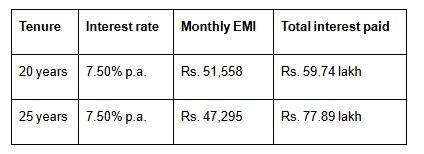
Her EMI for a 20-year tenure is approximately 43% of her monthly income - within a typical lender's threshold. If she extends the tenure to 25 years, the EMI drops to approximately 39.4% of her monthly income, giving her more monthly room. But over 25 years versus 20, she pays Rs. 18.15 lakh more in interest.
Richa's decision will depend on whether she is comfortable with her current income absorbing the higher EMI, or whether she'd rather keep her monthly outgo lower and use the freed-up cash for other goals. A CIBIL Score above 725 puts her in a strong position to negotiate better terms.
What should you compare before choosing a home loan?
It's easy to focus on the rate alone, but the overall cost of a home loan includes fees, penalties, and conditions that vary significantly across lenders.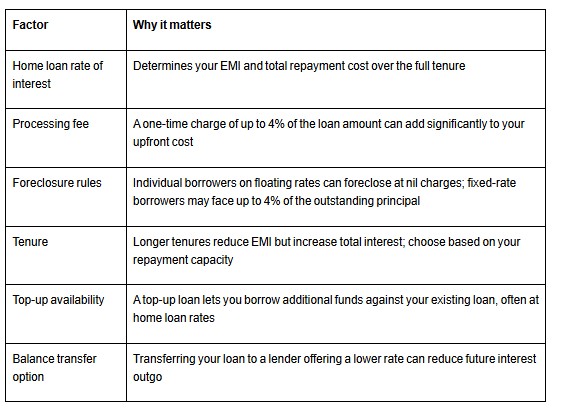
Reviewing all six before you apply can save you a significant amount over the loan term.
What financing options are available today?
If you are looking to buy a home, refinance an existing loan, or access additional funds, there are three structured options from Bajaj Finance worth knowing about.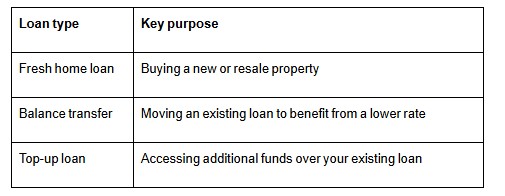
Bajaj Finance offers home loans of up to Rs. 15 crore*, with tenures extending to 32 years* and approval in 48 hours* of application. A top-up loan of up to Rs. 1 crore* is available for balance transfer customers, usable for home repairs, medical expenses, or other needs. Interest rates for salaried applicants starting at 7.25%* p.a.
There's no foreclosure charge for individual borrowers who choose a floating interest rate, which is a meaningful saving if you plan to repay early.
Who can apply?
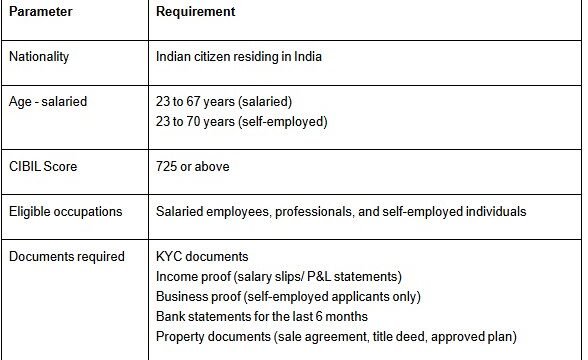
Check these criteria before you apply. Meeting them clearly improves your chances of approval and can reduce processing time.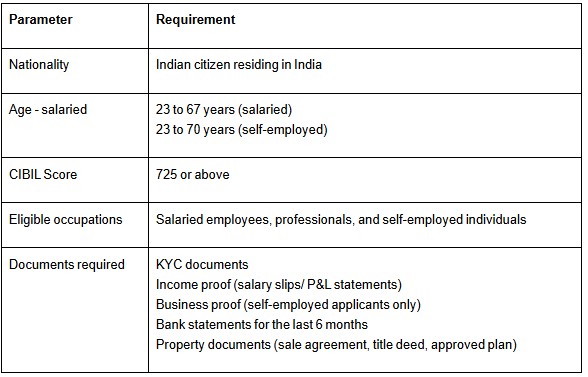
How to apply for your Bajaj Finance Home Loan online
- Click on the 'APPLY' button on the Bajaj Finance home loan page.
- Enter your full name, mobile number, and employment type.
- Select the type of loan you wish to apply for: fresh, balance transfer, or top-up.
- Generate and submit your OTP to verify your phone number.
- After OTP verification, enter your monthly income, required loan amount, and confirm whether you've identified the property.
- Enter your date of birth, PAN, and other details as requested based on your occupation type.
- Click 'SUBMIT.'
- A Bajaj Finance representative will contact you and guide you through the next steps.
Is now a reasonable time to apply?
Affordability in 2026 is not just about finding the lowest home loan rate of interest - it depends equally on your tenure choice, total borrowing cost, credit profile, and down payment. Before you apply, compare processing fees and foreclosure terms alongside the rate, and calculate total interest across different tenures. Review your eligibility criteria to avoid unnecessary credit enquiries. If you are ready to take the next step, the Bajaj Finance Home Loan offers amounts up to Rs. 15 crore*, tenure of up to 32 years*, and approval within 48 hours* - check your eligibility and apply online today.
(ADVERTORIAL DISCLAIMER: The above press release has been provided by NewsVoir. ANI will not be responsible in any way for the content of the same.)
